Wednesday, August 15, 2012

Private Wild Horse Sanctuary Fundraiser - Saturday August, 18th

Volunteers Alaina Welsh (from left), 17; Charissa Gurnea, 22; and Ashley Lawrence, 22, work with horses Friday at the Wild Horse Sanctuary in Shingletown.
Charissa Gurnea works with Wesley at Wild Horse Sanctuary in Shingletown.
PHOTO BY GREG BARNETTE // BUY THIS PHOTO
Charissa Gurnea works with Wesley at Wild Horse Sanctuary in Shingletown.
SHINGLETOWN — Dianne Nelson likes to call it a "friendraiser."
The open house she's held annually at the Wild Horse Sanctuary for the past nine years happens again Saturday, and she's looking forward to meeting new people as well as seeing familiar faces.
It's also part benefit for the 300 or so wild mustangs and burros she shelters on her 5,000-acre spread.
Nelson planted 30 acres of hay this year to help offset higher prices for the 300 tons she purchases each year. She also cleared an additional 30 acres of brush to plant native grasses in the fall.
....
But for now, anyway, she's having a party. Highlights of Saturday's free event include docent-led walks to view the mustangs and burros up close and free horse rides for children 10 and younger.

(Please see above link for the rest of the article.)

Friday, August 10, 2012

Anyone remember the Texas 25 saved from Presidio?

Here is information on the Texas 25, originally destined for slaughter but rejected by Mexican authorities and left to starve at the Presidio holding pens.

Those 25 were the lucky ones, as others in worse shape were dragged out into a dry wash and left to die.

Firelight South Ranch of Alpine, Texas knows of a few more in need. These are ranch horses turned out in the Big Bend, Texas area a few years ago, picked up, taken to auction, and now are in need of help. Mares and filly have been purchased by the rescue, but they are still in need of hay, vetting, etc. Please help if you can.

Here is their Facebook page:

and a link to chip-in for the current rescue effort. (8/28 - Goal was reached with the help of a generous donor).

Wild Horse Advocacy issue made easy by Laura Leigh

reprinted from Horseback Magazine:


Wild Horse Education Issues Challenge to Board Member Assertions


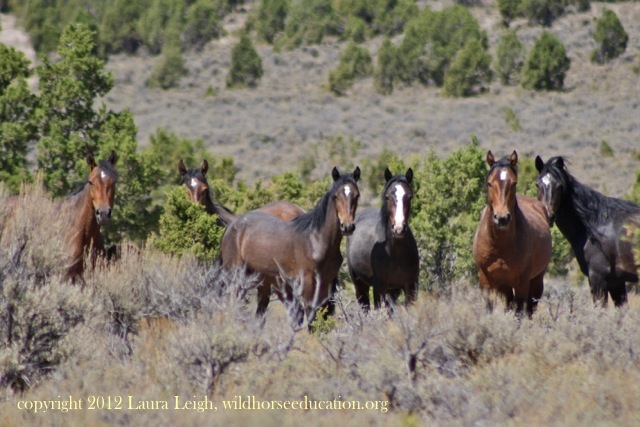
Photo by Laura Leigh, Horseback Magazine
RENO, (Wild Horse Education) – On July 31, 2012 at the Nevada Department of Agriculture meeting Dr. Boyd Spratling requested an Agenda item. He has requested that the Nevada Department of Agriculture (NDoA) create “letters” to various officials addressing the BLM Drought management plans (specific Item Battle Mountain).
Dr. Spratling is a member of the NDoA Board and also a member of the National Wild Horse and Burro Advisory Board.
Dr. Spratling did not discuss any specific to the Drought EA of the Agenda item in his presentation but created an overview statement that addresses removal of wild horses as the mitigating factor for drought.

Horses near the area of one of the water hauls in Fish Creek, June 2012
He failed to present any provision in the WFRH&B Act that is the legislation whose intent was to protect these animals as integral and to be managed as “wild” on public lands. He failed to address the real damage to the range being caused by over utilization by domestic livestock.
We ask that you take this opportunity to craft your own letter to representatives in Congress and those within the BLM/DOI structure. Suggestions of recipients are: Ken Salazar (Secretary of the Interior), Mike Poole (acting Director of the BLM), Amy Lueders (State Director, Nevada) as well as your Congressional representatives.
Suggested Recipients
Acting Director BLM: Mike Pool
E-mail: mpool@blm.gov
Edwin Roberson BLM
Assistant Director, Renewable Resources and Planning
1849 C Street NW, Rm. 5644
Phone: 202-208-4896
Fax: 202-208-5010
E-mail: Edwin_Roberson@blm.gov
BLM Nevada State Office,
State Director, Amy Lueders
same address:
Deputy State Director, Natural Resource, Land & Planning: Raul Morales
1340 Financial Blvd.,
Reno, NV 89502
Links of Interest:
http://agri.state.nv.us/
http://www.blm.gov/wo/st/en/info/newsroom/2012/february/blm_announces_three.html
Sample Letter:
August 4, 2012
Ken Salazar, Secretary of the Interior
Department of the Interior
1849 C Street, N.W.
Washington DC 20240
Ken Salazar,
This correspondence addresses the current drought issues in the state of Nevada with particular emphasis on the Battle Mountain District.  The necessity to craft this letter has come after attending the Nevada Department of Agriculture meeting on the 31st day of July this year, 2012.
During the meeting of the Nevada Department of Agriculture Dr. Boyd Spratling presented a recommendation letter to be sent to you from the Board. At no time in his presentation did he address any site-specific (current) information. At no time during his presentation did he recognize the need to evaluate good business practices involving the overgrazing (documented) by domestic livestock on a public resource.
In light of the presentation and subsequent letter you will be receiving from the Nevada Department of Agriculture we offer the following:
First we would like to commend the Battle Mountain District for showing the forethought to create a drought plan prior to the necessity of action. Proactive management practices are sorely needed in public lands management and should be recognized when they occur.
Secondly the damage to the range by permitees that currently utilize many ranges, not only in the Battle Mountain District of BLM, must be assessed on a site-specific basis. Any permitee not protecting public resource through over grazing or causing over grazing through water hauling on public lands must be restricted. Voluntary compliance is always preferred, but if that compliance is not forthcoming formal restrictions must meet with National support.
Third the proactive actions need to be extended beyond the drought. Each use of the land causes an impact to other uses and users. As livestock permitees turn out their animals site specific monitoring of range health prior to, and post, use must be supported. Improper use of one allotment creates a greater impact to neighboring allotments as well other uses. Impacts to other uses as turnouts occur must also be monitored. Impacts to wild horse movement patterns also need to be monitored as these instances create artificial instances of wild horse impact as animals are forced into smaller and smaller areas by fence line closures and considerable numbers of domestic livestock.
In addition the current economic impact to private land grazing operations and those that must supplement feed (provide hay) is considerable. Many American farmers are taking advantage of foreign markets for their products and the price of hay has risen considerably. The current cost for a private enterprise has risen to approximately $10.00-$18.00 per cow/calf pair monthly. The American public is selling their grazing resource to private permitees at current costs from approximately $1.35-$2.00 for the same resource. Public permitees also do not pay a property tax for the grazing land they utilize. This imbalance is particularly unfair to the American public, as the resource is not being properly protected for future use. Consideration of a fee scale that more appropriately reflects current market rate, that perhaps has a built in scale that can reward those properly utilizing public resource, would be appropriate.
We implore you to recognize this crucial juncture in the Wild Horse and Burro Program. A failure to define clearly a viability of use standard for this mandated legal user, of a small portion of public land, has created a crisis. The Crisis not only exists in over burdened holding facilities but on the range itself.  At no time have these populations been managed as “wild and integral” as intended by Congress.
Before any more removals occur on public land a true viability standard must be created. Faulty boundary lines must be evaluated. Genetic viability to each herd must be understood and protected in a manner reflective of a wild population (a population able to reproduce itself, even with a stochastic event) must be defined as outlined by law. The resources required to sustain those populations must be protected prior to other uses being permitted.
The wild horses and burros, under law, have nowhere else to go. They must be protected within the boundaries that have been established until those boundaries are re-evaluated and corrected.
Other uses have considerable public resource to draw upon.
Attached is a site-specific report on an HMA in the Battle Mountain District. It clearly demonstrates that many areas have, and are, being over utilized by private interests creating artificial impact on a population of wild horses that are (under law) to be managed as wild and integral.
We urge you to support the proactive actions currently transpiring in the Battle Mountain District. We implore you to urge the District to continue to create proactive plans toward creating an actual equity of utilization and protection of public resource. True “multiple use” does not operate in derogation of other uses or users. It strives to understand the complexity of interaction that begins with complete and accurate conversation.
Sincerely,
your name
contact info
More info: http://wildhorseeducation.org


Leave a Reply

Tuesday, August 7, 2012

N Landers Complex response to EA

Please excuse typos. Theses are my comments submitted to Scott Fleur regarding the proposed North Lander complex roundup and their preferred alternative which includes treatment of up to 60 mares with SpayVac and a removal to the low AML.


Ldg
..........
........, ...


August 7th, 2012

Scott Fleur
BLM Landers Office
1335 Main Street
Lander, Wyoming 82520

phone 307 332 8400
fax 307 332-8444


Dear Scott Fleur,

First of all, it's detailed document with the exception of the difficulty of finding some very important information. That is, nowhere in the document can I find the percentage of livestock utilization though the number of AUM's allotted to livestock is well over 40,000 (over 3,333 cattle on the Lander's complex HMA's every month of the year). (Appendix 6) 

I am always amazed at your agency's chutzpah when it comes to livestock. You simply don't seem capable of understanding that 40,000 AUM's allocated to livestock is NOT "evening out the use" as JoLynn Worley put it a few months ago. So, yes, you could consider at some point allocating more AUM's to wild horses and you certainly have the latitude to leave more than the minimum AML on the complex once the roundup is completed.

And like many advocates, I'm concerned about the SpayVac. I'm more than a little surprised its being considered for field use so soon since the Paul's Valley study started barely a year and a half ago and there are no published reports as of yet. (Or are there?)

I've also included quotes from BLM Press Releases and the BLM's own website that express reservations about using the vaccine until the results of the study become known.

Bureau of Land Management
Contacts: Paul McGuire (Oklahoma) (405-794-9624) Heather Emmons (Nevada) (775-384-7966) Tom Gorey (Washington, D.C.) (202-912-7420)
For release: Tuesday, April 26, 2011
"The goal is to see if SpayVac®, a novel formulation of a glycoprotein called porcine zona pellucida (PZP), will provide a longer-term effect than other PZP vaccines currently used by the BLM.  If the vaccine is found to reduce foaling in this controlled setting, it will be considered for use with free-roaming horses to help control population growth rates on the range."
AND ALSO:
"SpayVac™ is an experimental fertility control vaccine using PZP antigens. A single vaccination with SpayVac™ has maintained a high level of contraception throughout the 4-year Nevada estray horse study. There is no regulatory approval for the management or investigational use of SpayVac™ through EPA or FDA. There is no SpayVac™ available for investigational use and no one is currently making it. Data is not available that describes the impact of SpayVac™ on the behavior and physical health of the mares. SpayVac™ may have potential for use as an effective, longer-lasting fertility control agent in the future. It may also offer an alternative to spaying mares in the future. However, additional research over the next 5-10 years would be needed before it could be used on a population-management basis."
My question is this. What do you know about the Spay Vac vaccine that would cause you to hurry up and test it for field use? And why are you testing it in a relatively large area like the North Lander Complex when fertility control projects are better tested in smaller HMA's like the Pryor Mountains?
What seems to be "out there" in terms of information is that Spay Vac is effective on reproduction rates but that its effects are not reversible in all mammals. 
Because of those concerns, I would ask you to use the PZP-22 instead of the SpayVac until more information is known. I would also ask you, if you insist on using the SpayVac,  to release more than the low AML.
While I'm sympathetic to the need for fertility control, I object to the counting those 60 SpayVac experimental mares as part of the low AML especially and in case many of the mares have their reproductive ability severely compromised.
I was also shocked that you would consider an Alternative that would geld stallions and return them to the HMA. While glad that is not the preferred alternative, returning geldings to the HMA is not very efficacious in lowering birth rates as your chart indicates, and is a direct violation of the viable herds mandate. So is sterilizing mares. Please be careful that you don't do either of those to the North Landers complex horses.
Regards,

Friday, July 6, 2012

If you can count wild horses, you should be able to count cows, too.

Recently an advocate shared an e-mail conversation she had with the BLM and asked for people to follow-up.

Here are my comments emailed this morning (7/06/2012) to JoAnn Worley, BLM spokesperson.

_________________________________________________________________                    

Ms. Worley,

I was allowed to read part of an email you sent to an advocate recently and wanted to correspond with you about some of your comments. I hope I don't take anything out of context, but here goes. FYI, your comments are in blue, all quotes from the BLM website or from internet articles are in red and my comments are in black.

First of all, you stated:

  • --The land wasn’t “taken” from the wild horses.  Herd management areas were determined in 1971 based on where wild horses were on the public lands at that time.  

 The BLM actually has "taken" over 22 million acres from the WH&B program since its inception. Please read your BLM Myths and Fact page below :  


Myth #3:  Since 1971, the BLM has illegally or improperly taken away more than 20 million acres set aside for wild horses and burros (from 53.8 million acres to 31.6 million acres).
Fact:  Of the 22.2 million acres no longer managed for wild horse and burro use:
Do we really need to get into semantical differences between "taken" or "no longer managed", or "removed" or "decimated" the fact is that acreage has been erased from use by wild horses and burros and those HMA's have been "wiped out" by your agency.  While no specific amount of acreage was set aside, that part of the response is disingenuous at best as many of the BLM determined herd areas are now gone as in they have ceased to exist. Since there were horses in those HMA's when the law was passed in 1971 to say that you have "taken" land from the wild horses is correct. And every year, the BLM wants to erase more HMA's and remove all the horses, such as what your agency currently plans for Colorado's West Douglas Herd.

You also said:

--Livestock use is controlled by month; wild horses use an area year-round.  There isn’t a bias, it is a way to average the use.  

Once again, I am confused by your comments. Divide the livestock AUM's by 12 and you can easily compare the numbers of cattle allotted to the HMA's and the number of horses allotted to those same HMA's for a 12 month period. In nearly ALL cases, except where the HMA's are designated as wild horse ranges, the allotment of AUM's for cattle exceeds the allotment for wild horses. And in many cases, the part of the year the livestock can be on the range is six months or more. Saying the livestock use is controlled by the month is meaningless unless one knows how many months the livestock are allowed usage on each HMA and in many cases, it's far more than a month and also in many cases it's in the prime part of the year for forage and water supply.

Let's take the Jackson Mountain HMA and information found on the BLM website as just one example.


The HMA acreage comprises 31% of the total allotment acres. There are a total of nine livestock operators (permittees) currently authorized to graze livestock in these allotments annually.  The total permitted use for these permittees is a combined total of 32,744 Animal Unit Months (AUMs) yearly in the six allotments (including on non-HMA lands).
There is a lot of information missing from the BLM data provided on livestock grazing, but here are some questions for you. Is livestock grazed evenly across the areas mentioned which include the HMA; how many months of the year is the allotment utilized; and what percentage of the allotment is utilized? 

Forging ahead regardless, rough math (and I think I have it right) tells me that 31% of 32,744 is 10,150 AUM's or up to 1690 livestock AUM's (cattle) six months of the year or up to 845 livestock (cattle) every day of the year. Those numbers are four times the Wild Horse upper AML and over five times the lower AML in the Jackson Mountain HMA if the allotment is 100% utilized.

The appropriate management level (AML) range established for the Jackson Mountains HMA is 130-217 wild horses. 
Surely someone in your office, when contacting the permittees  about the drought, asked them how many cattle (or livestock) they had on the range and received an answer. That would be the first question I would have in similar circumstances. How could your agency NOT want to know this information in order to better understand range utilization during a drought? So, here is the question that I have not seen in any BLM response. How many cattle are on the Jackson Mountain HMA and how many months of the year are they allowed to be there.
--The BLM has tried everything that you can imagine, including conflict resolution. Advocates want changes that would require the action of the U.S. Congress.  The BLM doesn’t create the laws, we follow them.  

The history of the DOI and the BLM would suggest otherwise. Who went to Congress to amend the Wild Horse and Burro act to allow the use of helicopters in roundups if not the BLM?

And are you aware that the multiple use philosophy actually originated within the DOI? Please read the excerpt below;


"A fledgling multiple use philosophy within the Bureau was legally endorsed for the public lands in the Classification and Multiple Use Act (CMU Act) of 1964. BLM was reorganized to reflect new programs and authorities under this mandate: concerns for wildlife, recreation, soil, and water resources were integrated into traditional programs (range, forestry, lands, and minerals) through a land use planning process.
Inspired by the conservation accomplishments of Theodore and Franklin Roosevelt, Secretary Udall launched the nation's "Third Conservation Wave" by requesting a new legislative mandate for the public lands from Congress. Part of this agenda included formal recognition of multiple use management on BLM lands, patterned after the Forest Service's Multiple Use Sustained Yield Act of 1960. Other components centered on getting BLM a more flexible land sale authority and repealing outdated settlement acts…"
The phrase in bold bears repeating … .. "Secretary Udall … requesting a new legislative mandate."  JoAnn, the BLM is fully capable of going to Congress and requesting changes and has done so in the past. So, saying the BLM doesn't create the laws is simply not based in historical precedent.

In closing I want to remind you why wild horses advocates continue to perceive a bias under the current administration. When Ken Salazar was appointed Secretary of the Interior, did he immediately start reforming the Minerals Management Service which had had known problems prior to 2008? 


No, his first big policy move I became aware of was to declare a massive roundup and removal of America's wild horses. While the oversight on wells like the Deepwater Horizon, which ultimately blew, was lacking; while West Virginia mines were crumbling, he was busy plotting his big move on America's wild horses. People died off the coast of Louisiana and people died in West Virginia, but our cattle ranching Secretary of the DOI  was going to solve that "wild horse problem" come hell or high water. Only after two disasters and public uproar did he turn his attention to MMS. Hasn't worked out very well for the victims who lost their lives and their families, has it?

Best Regards,


Lisa 


Texas Senate trying to backdoor horse slaughter re-start.


Courtesy of EWA

RT & Jerry 
Today's News 

Your support is needed in Austin on July 10. Everyone is encouraged to testify. If you choose to voice your opposition to horse slaughter, you will be allowed 3 minutes to speak. Since the attendees will NOT be signing cards showing opposition, strong opposing attendance extremely important.

As a bonus for attending, you'll be able to hear ol' Charlie Stenholm spewing his propaganda in person. That should get you on your feet to say a few words!


Let's show them the 80%.


Here are the details:


Committee: Agriculture and Rural Affairs

Time & Date: 1:00pm, Tues, July 10, 2012

Place: E1.028 (hearing room)

Chair:  Senator Craig Estes

The Senate Committee on Agriculture and Rural Affairs will meet to discuss the following interim charges:

Interim Charge #1: Study and make recommendations for ways to increase investment, employment and production in Texas agriculture. Include a review of current land use and market trends as they relate to agricultural use and make recommendations for ways to support and enhance small farm and ranch operations.

Interim Charge #3: Assess the current veterinary medical workforce, and make recommendations to address any disparities between small animal (companion) and large animal (food/fiber) veterinarians. Review the Rural Veterinary Medical Loan program (RVML) and make recommendations to enhance the use of RVML funds and other funding sources to increase the veterinary medical workforce.

Interim Charge #4: Review the impact of state laws relating to the closure of horse slaughter facilities across the United States. Analyze the impact on the equine industry and agricultural sector of the Texas economy.


The Committee will hear invited and public testimony. 


# 


cc horse

Template design copyright Terry Fitch | Image copyright John Holland
Logo copyright Lissa Brooks & Joan Dillon
# 

paypal 

       Join Our Mailing List       facebook


This email was sent to stevenlong@horsebackmagazine.com by vicki@equinewelfarealliance.org  
Equine Welfare Alliance | PO Box 6161 | Naperville | IL | 60567
http://campaign.r20.constantcontact.com/render?llr=omaglqdab&v=001wGH4ADbzDTuQPD58UaPQVG8UHF-SEz8iFmMIv9QtGw1LTerSPo-76OgdlqaECs1D_fTz83531ehTD7NfZRchLzDoeZEf4aWkp1Y82UfcCkHca3dGFMsqE5zbRrVKRKEUmy0qkPOPlzeWxvuroPZ1tA%3D%3D