Friday, October 5, 2012

Comments on Triple B/Maverick/Antelope roundup


(I used the comment form at AWHPC and their provided comments sent it to the BLM. Usually I read the E/A's and send in my own comments but no time to do that these days. This is just here for my records).

The Proposed Action continues the BLM’s failed capture-remove-warehouse cycle, which has created a fiscal crisis for the Wild Horse and Burro Program. I support water/bait trapping for the application of PZP or PZP-22 in order to humanely suppress population growth without removing horses from the range. 

I urge the Wells Field Office and Elko District to cancel plans for the removal of wild horses from the Triple B, Maverick-Medicine and Antelope Valley Herd Management Areas (HMAs) as outlined in Environmental Assessment (EA). The Proposed Action in the EA fails to outline the specific number of horses targeted for removal and fails to provide an adequate justification for the continual removal of wild horses from this area over a five-year period during which environmental conditions will change. The BLM must re-evaluate the Proposed Action on an annual basis in order to evaluate the need for the action in light of the changing environmental conditions, as well as to provide the public with opportunity to comment on the rationale behind decisions to conduct wild horse removals into the future.

The EA failed to take a hard look at the following issues that would mitigate the need for the Proposed Action:

- Manage the existing population (which only exceeds high AML by a few hundred wild horses) by using non-hormonal, safe and reversible PZP fertility control to suppress population growth. This alternative was not even considered or analyzed as a means to mitigate the Proposed Action of wild horse removals.

- Relocate any horses outside of the HMAs back into the designated area instead of removing them, and remedying the conditions that are causing horses to leave the HMA. The EA failed to outline how the horses were leaving the HMA - instead claiming that horses would only return to the areas outside the HMA. The BLM must "take a hard look" and analyze the reasons why horses are leaving the HMA, possible remedies to this problem and evaluate the other possible actions before jumping ahead with the agency's intention to implement the Proposed Action.

- Increase, either temporarily or permanently, the dangerously low "Allowable" population levels (aka AMLs) for wild horses in the HMAs. The EA failed to give any consideration to temporarily increasing the number of horses in the HMAs, failed to take a hard look at and consider BLM’s Adaptive Management Policy (established by Interior Secretary Order N0. 3270, March 9, 2007), failed to analyze the BLM's authority pursuant to 43 C.F.R. 4710.5(a) and 43 C.F.R. 4710.3-2 to increase forage and habitat for wild horses. 

In addition to above mentioned deficiencies, the EA failed to provide the information below, which was specifically requested by the public to be analyzed during the scoping period for this EA/Proposed Action:

- Provide all forage allocations, usage (Animal Unit Months or AUMs) and listing of livestock grazing allotments within the HMAs for each of the past three years. Include all current grazing and projected grazing for the next 6-12 months.

- Provide a full accounting of all water sources on the range, including how fencing and engineering of wells and springs for livestock grazing has impacted water availability for wild horses and other wildlife species. 

- Provide information on location of all fencing within the HMAs. 

- Thoroughly disclose all genetic data on each of the herds (all genetic reports should be provided in the EA appendix); analyze the impacts of the proposed action on the genetic health of each herd and the individual animals. 

- Provide all monitoring data for each area, which includes data that clearly separates the impacts on range conditions of livestock use from wild horse use.

- Provide data that demonstrates the BLM’s knowledge about how cows utilize the environment, including data about usage of stream riparian areas.

- Disclose all predator-killing activities within and around the HMAs. The mounting data on the impact predators can and do have on wild horse population growth must be adequately addressed through the disclosure of predator-kill data, analysis and an alternative must be considered for the BLM to support the protection of predators in and around the HMAs in order to restore a Thriving Natural Ecological Balance (TNEB).

I expect that the BLM will re-issue the EA with the above requested level of detail and analysis needed for informed decision making. I further expect that BLM will provide a full accounting of how many members of the public submit comments on this EA and what their positions are, as the agency is legally required to do under the National Environmental Policy Act.

Regards,

Wednesday, September 19, 2012

I didn't used to hate them (the BLM) ...

but now I'm pretty sure I do

Below is my response to the BLM's request for comments on the scoping document for the Pickens' Wild Horse Sanctuary near Elko, Nevada. Comments were due Wednesday, September 19, 2012. The BLM proposal is outrageous, inflexible and pretty much shows that the are trying to make the sanctuary fail and if they can't do that, they want to make sure advocates are as unhappy with Ms. Pickens as possible.


I see lawsuits in the future if the BLM gets away with their preferred alternative, which is to wipe out three HMA's, geld all stallions currently living there and removing mares are foals. Fencing in the whole allotment which is a ridiculous and expensive burden to place on Pickens and turning three viable herd management areas into herd areas which by definition, contain no wild horses and can not ever be returned to viable herd status is simply another example of the BLM's rigid and narrow view on the validity of the 1971 law.

Some of my comments were gleaned from the careful words of others. Some of the more bitchy, outraged parts are pure me.

September 19, 2012


BLM Elko District Office

Wells Field Office, 

3900 E. Idaho Street, 

Elko, NV 89801,


 Attn: Wild Horse  RE: Eco-Sanctuary, 
Fax at (775) 753-0385. Comments may also be submitted to the project e-mail address: EcoSanctuaryComments@blm.gov.
To Whom It May Concern,

The first comment is why don't you include contact information in your scoping letter? Eighteen pages of BLM documentation and pictures, ostensibly submitted online for comments, yet there is no address, no phone number, no fax number nor contact information included anywhere. This is not the first time I have read a scoping letter or E/A that has no contact information included. Why do you omit contact information in a document that has been designed to elicit comments?

Regarding your scoping document on the Nevada Eco-sanctuary, I have supported Saving America’s Mustangs’ (SAM’s) goals for the creation of a wild horse “eco- sanctuary” in northeastern Nevada from the very beginning. I thought the idea of returning horses to their original environment, utilizing the allotment for the benefit of the public to be able to see wild horses that aren't hidden away on private holding areas with little viewing except for occasional, selected, carefully controlled tours would be a great idea for people who want to see the beauty of wild horses and understand their role in the west.

However, I insist that these goals MUST BE accomplished without negatively impacting the wild horse herds living in the three Herd Management Areas (HMAs) that comprise the Antelope Complex . I truly believe that your plans for the eco-sanctuary, as alluded to in the scoping document and mentioned in the public meetings held a few weeks ago are the worst of all worlds for advocates and points to the worst of all futures for wild horse herds. What has been alluded to in public meetings is to wipe out the three HMA's that are included in or part of the Spruce allotment, gathering and removing all mares and foals, gelding all the stallions that currently live in those HMA's and re-designating those areas Herd Areas which will keep them from ever becoming HMA's at some future point should the sanctuary cease to exist. Has the BLM has ever looked at the SAM proposal in good faith, understanding that wild horses need to be protected on their designated lands while trying to come to a solution that was acceptable to all instead of this scorched earth solution that in essence removes three more Herd Management Areas from existence? 

Even though the BLM has come up with a variety of excuses for reducing the number of HMA's on public lands in the past 40 years, removing 111 herd areas representing over 20 million acres in the process, there is no law that says that the wild horses can't remain on the three HMA's that the Spruce allotment affects. In fact,  (Public Law 92-195) #1334 states “Nothing in this section shall be construed to prohibit a private landowner from maintaining wild free-roaming horses or burros on his private lands, or lands leased from the Government, if he does so in a manner that protects them from harassment, and if the animals were not willfully removed or enticed from the public lands.”

Jo Worley has said that the BLM does not make the laws, but if it re-interprets old ones it doesn't have to make any new ones. And in this case, your interpretation establishes a harsh and unyielding precedent, one that certainly alters the spirit of the 1971 legislation. Do you have any indication that SAM would want the horses in the three existing herd areas removed and stallions gelded? And please do not respond by saying that SAM has agreed with your proposal to remove them. That is not that same as Pickens' saying she doesn't want or won't accept the herds that currently roam on the Spruce allotment.

To be true to the spirit of the 1971 law, any eco-sanctuary proposals must be evaluated according to the following criteria to ensure the following:
Will not result in a loss of habitat (HMA acreage) for non-captive wild horse or burro populations;
Will not reduce Appropriate Management Levels (AMLs) for non-captive wild horses and burro populations;
Will not convert wild free-roaming populations or portions of populations to non- reproducing herds, as this would violate both the BLM’s mandate under the Act and its regulations.

In addition, I can't find any real justification in the scoping letter for the fence. The BLM has stated numerous times that wild horses, once in captivity, learn new behaviors and don't always adjust well to the wild. One of those behaviors is learning that they don't have to range far and wide for their food when pastures are lean. Certainly your gelding in holdings have learned some of these behaviors and it would be easier to control their movements with supplemental feed and water sources based on some of these learned behaviors. Until this is tried and found completely unworkable, I object to the establishment of the fence as a necessary part of the eco-sanctuary. And if they horses do the "unacceptable" and wander off the sanctuary, Pickens can just go get them, using some of the taxpayer funded stipend to do so. 

I also don't find any mention of migratory routes for wild horses (or any other wildlife). Where are those routes and why aren't they mentioned so that those routes can be discussed?

I support creation of a sanctuary where horses otherwise residing in holding facilities can live and roam. That can be easily done with the part of the proposal that turns the AML's for cattle into AML's for horses. However, I object to any attempt by the BLM to use an “eco-sanctuary” as an excuse for reducing the number of wild horses who are protected under federal law and/or the acreage available to them. You need to change your plan as it stands and incorporate the options mentioned above.

Sincerely,


Monday, August 20, 2012

The Shell Game?

In June, Wild Hoofbeats (and nearly 200 other interested people) travelled near El Dorado, Kansas to tour Bob Buford's Shadow 7 contract holding facility, the only LTH facility tour scheduled by the BLM for 2012.

Long Term Holding Tour in Kansas

The following is a quote from her blog:

"Paul McGuire from Oklahoma told me that only 1000-1500 horses were sold per year from long term holding, but when I had an opportunity to speak to Bob Buford myself, those figures seem low.  He told me had had just sent 200 to a couple of different states, and this last year had sent 1700 to Hutchison Correctional Facility. He told me that the mortality rate is about 3 – 4% and the horses can live to 25 or even 30, which is a good 5-10 more years than in the wild."

McGuire's comments got me to thinking. I spoke to Bea Ward earlier this year about horses being sold out of their long term holding facilities (see bottom of linked page for numbers sold 2009 - 2012) and what she told me doesn't jive with what McGuire is to have said. Ms. Ward told me that far fewer are sold yearly and also said that few had been sold since the LTH horses were found on Texas Kill buyer's truck heading southbound to Mexico for slaughter. Ms. Ward said sales were pretty much on pause at the time until Sally Spencer was able to re-write and toughen up their sales agreement so that incidents like this don't re-occur. Now a good number of these sales are sold to Extreme Mustang trainers but some go to a place in Colorado. I asked Bea for some more information on the Colorado buyer but she couldn't tell me more.  It all seemed like a dead end so I didn't do any more follow up.

However ...... 

Some of the discrepancy between the web site numbers and McGuire's numbers I can chalk up to McGuire probably "estimating", but between what he said and what Buford said clearly is cause for alarm, especially if you consider 1700 horses transferred out of one facility and extrapolate that to the nearly 20 other LTH facilities. I'm not saying all facilities transfer horses, but even if a few of them do, the logistics would be a nightmare. How do you ever account for the numbers being moved or where the horses finally end up because that is the real concern. Transfer them enough times and even the best software might not be able to keep track. Remember sales are not transfers, so though we have the sales numbers for the past few years, we don't know how many horses are transferred from LTH facility to LTH facility (or even why they are transferred).

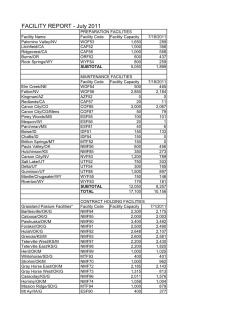
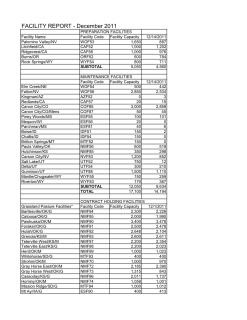
Here is where I really start to have questions. Buford says he transferred 1700 horses to Hutchison (prison maintenance facility). Please note the numbers for Hutchison remain essentially unchanged throughout 2011 and into 2012 and that numbers is around 290 horses, give or take. 

Here is the current BLM facility report for June, 2012

(also here http://www.blm.gov/pgdata/etc/medialib/blm/wo/Planning_and_Renewable_Resources/wild_horses_and_burros/statistics_and_maps/holding__adoption.Par.95446.File.dat/augfacrept.pdf)


The following links take you to facility reports for 2011. I have yet to learn how to make these documents larger in Photobucket but when I do will update this page. I don't have the facility report for December, 2010 to compare but don't know if it's all that important to this blog.

BLM facility report for July, 2011


BLM facility report for December, 2011


You see essentially the same number of horses in Hutchison currently as are in the previous facility reports for July and December, 2011 (less than 300 on all three reports) which I downloaded from the BLM site or were provided by BLM staff at my request. Please note that the capacity at Hutchison is 350 horses. Would it even be possible to move 1700 horses in and out in one year and have the number stay basically unchanged three consecutive facility reports?


So, was Buford misquoted? (Unlikely). Was he wrong about where he had sent the horses? That seems to be so since Hutchison didn't received anything like 1700 horses last year. Where did they go?


I will repost when I get a response on this from the BLM (right).

Saturday, August 18, 2012

7th annual conference on wildlife fertility control

Dan Baker, from the Department of Biomedical Sciences, CSU, will be presenting during this conference the first year efficacy rates from a fertility study of Gonacon on wild horses at Teddy Roosevelt National Park. First year efficacy rates were much lower than they expected. Results from years two and three not yet available.

Follow this link for registration and other information:


Wednesday, August 15, 2012

Horse Slaughter Applicant Gives Up After Being Fined $86,400 For Mountain of Dead Animals on Property

Note: August 31st: I just received all the information from Front Range's Lawyer, Mr. Bruce Wegman. The notice of fine is at the end of this blog entry. 

Reprinted from Front Range

BREAKING NEWS: 8/16/12

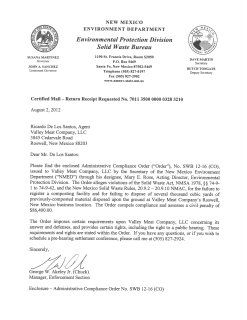
Horse Slaughter Applicant Gives Up After Being Fined $86,400 For Mountain of Dead Animals on Property 
Roswell, New Mexico’s Valley Meat Company Cited by New Mexico Environmental Board’s Solid Waste Division for Years-Long Violations of State Law
Roswell, New Mexico, August 15 -- When the first applicant for an American horse slaughterhouse operation surfaced earlier this year, Front Range Equine Rescue (FRER) immediately investigated in order to determine the nature of the applicant’s business.  FRER discovered that the applicant, Valley Meat Company, had a fifteen-foot high pile of dead cattle rotting on its property, creating a health hazard for the community and placing into serious question the operator’s ability to start up his new operation, slaughtering former American companion, work and competition horses for human consumption.  Pictures of the pile taken by both state and federal officials showed a horrific sight.  FRER determined that Valley Meat had been in violation of New Mexico law for years, specifically because its owners had been maintaining this massive public health and safety hazard on their property, without any proper or responsible abatement.  

Go here for rest of the Front Range report:

Below is a copy of the fine issued by the New Mexico Environment Department, Solid Waste Bureau.


Why do we even have to ask?

Below is part of a Horseback article on the status of Long Term Holding Pastures in Oklahoma which is in the middle of the area most impacted by the worst drought in decades.


BLM Will Not Move Captive Oklahoma Mustangs Despite New Dust Bowl Threat

By Steven Long
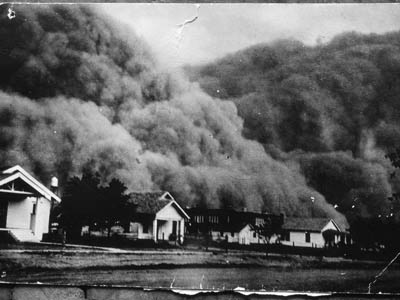
1935 WPA Dust Bowl Photo, Library of Congress
HOUSTON, (Horseback) – Little has changed in the federal Bureau of Land Management’s handling of wild horses under its Wild Horse and Burro Program, this in spite of the worst drought affecting Midwestern states since the dust bowl of the 1930s. What’s more, nothing will change, despite a threat from nature that could put thousands of animals in jeopardy.
Asked by Horseback if the BLM was making any special arrangements to move wild horses held captive in giant pastures in Oklahoma and Kansas, national BLM spokesman Tom Gorey responded:
“Despite the current drought conditions in the Midwest, wild horses on long-term pastures continue to thrive,” he said. “If current weather conditions do not change, pasture contractors may have to begin supplemental feeding earlier than normal.  Therefore, these wild horses will have the advantage of having someone that can address their immediate needs.”

Private Wild Horse Sanctuary Fundraiser - Saturday August, 18th

Volunteers Alaina Welsh (from left), 17; Charissa Gurnea, 22; and Ashley Lawrence, 22, work with horses Friday at the Wild Horse Sanctuary in Shingletown.
Charissa Gurnea works with Wesley at Wild Horse Sanctuary in Shingletown.
PHOTO BY GREG BARNETTE // BUY THIS PHOTO
Charissa Gurnea works with Wesley at Wild Horse Sanctuary in Shingletown.
SHINGLETOWN — Dianne Nelson likes to call it a "friendraiser."
The open house she's held annually at the Wild Horse Sanctuary for the past nine years happens again Saturday, and she's looking forward to meeting new people as well as seeing familiar faces.
It's also part benefit for the 300 or so wild mustangs and burros she shelters on her 5,000-acre spread.
Nelson planted 30 acres of hay this year to help offset higher prices for the 300 tons she purchases each year. She also cleared an additional 30 acres of brush to plant native grasses in the fall.
....
But for now, anyway, she's having a party. Highlights of Saturday's free event include docent-led walks to view the mustangs and burros up close and free horse rides for children 10 and younger.

(Please see above link for the rest of the article.)